

MenuClose
Intelligence on
your local server
No third-party frontier model ever sees your design. The models that touch IP are ours, and they run on your hardware.
Where the orchestrator saves you time
Five parts of one run, in the order they happen. One design, the tinytapeout regfile on sky130hd, carried from a brief through to a closed formal proof. Each claim below is answered by a recording of the session that earned it.
- 01
No hand-written TCL
One request sets up the whole flow.
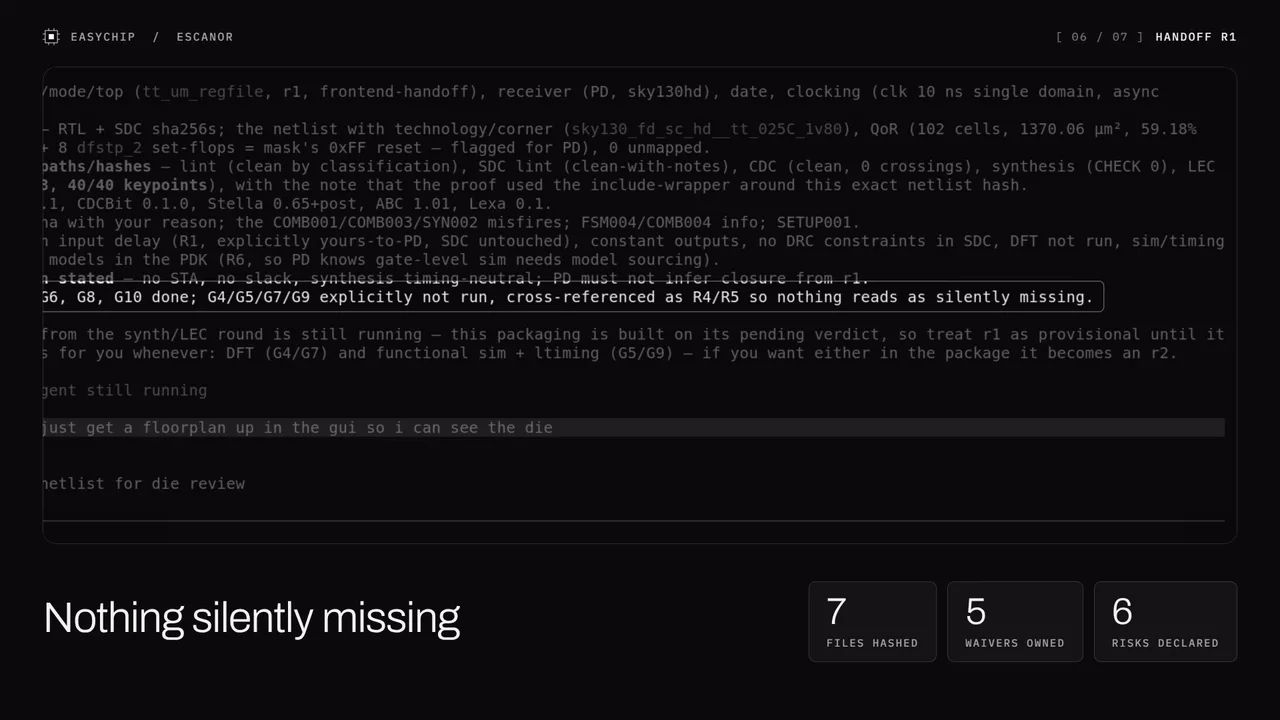
An engineer hands over a block and a target: the tinytapeout regfile, sky130hd, front end to PD. Escanor writes the plan, names the receiver, triages six lint findings down to the two a human has to decide, proves the netlist against the RTL, and packages r1 with every file hashed.
- 42
- Plan lines
- 6
- Findings, none real
- 7
- Files hashed
Escanor · tt_um_regfileWatch the run1:03 - 02
No silent changes
Every revision is proved against the last.
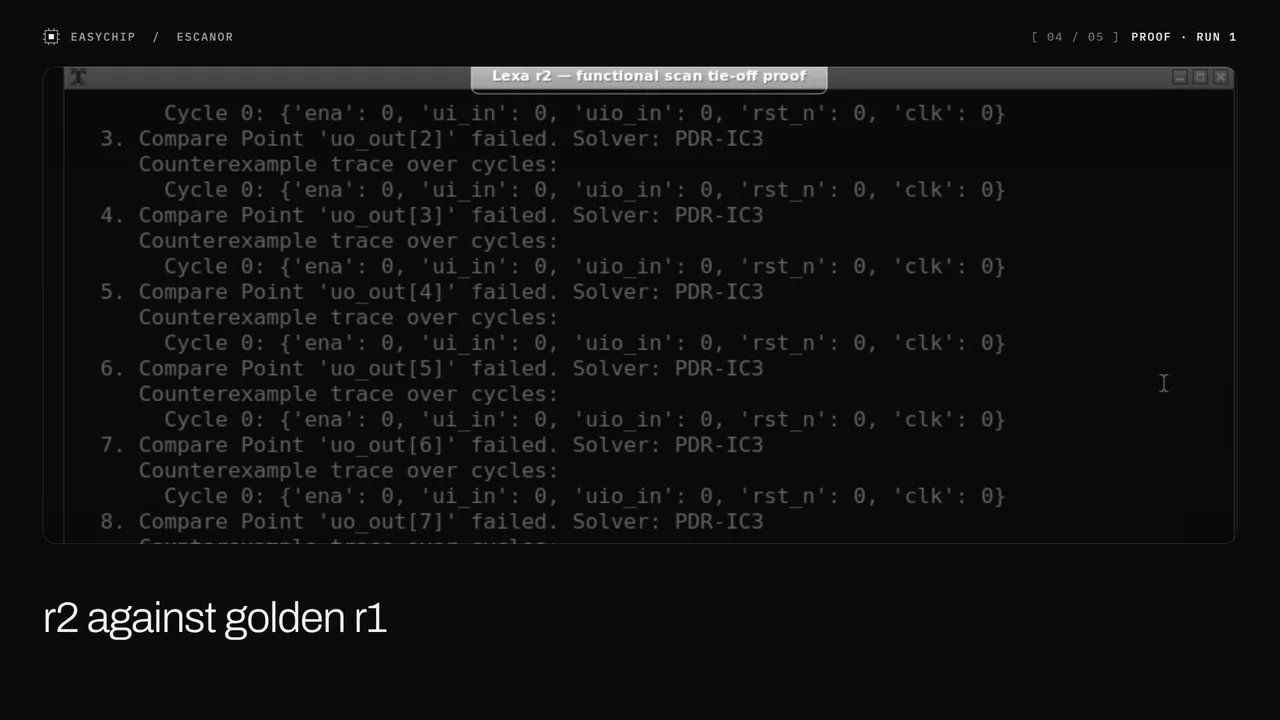
r2 adds a scan chain and generates patterns with the SAT engine, reaching 100% test coverage on 44 patterns. Then it proves r2 is the same design as r1. The first proof run failed on the outputs, and that log was kept beside the one that passed.
- 100%
- Test coverage
- 44
- Patterns kept
- 2
- Proof runs, first failed
Escanor · tt_um_regfileWatch the run0:53 - 03
No black box
Every engine runs in a session you can watch, and take over.
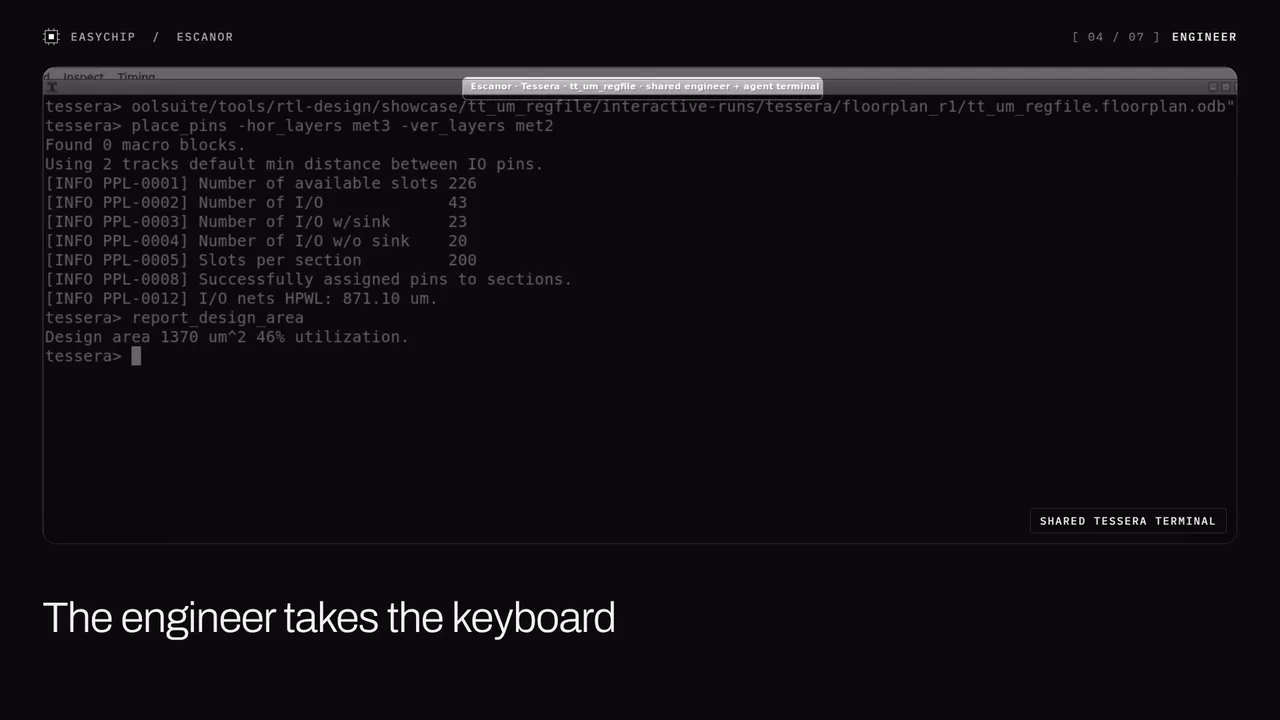
Tessera opens as a visible console and GUI, not a batch job, once the r1 hashes are checked against the manifest. The engineer takes the keyboard and redoes placement by hand. The clock tree is built on their placement, and the agent clears a routing error in place.
- 46%
- Utilisation, by hand
- 32
- Clock sinks
- 102
- Instances
Escanor · tt_um_regfileWatch the run1:25 - 04
No babysitting
It reads the logs, diagnoses failures, and reruns only what broke.
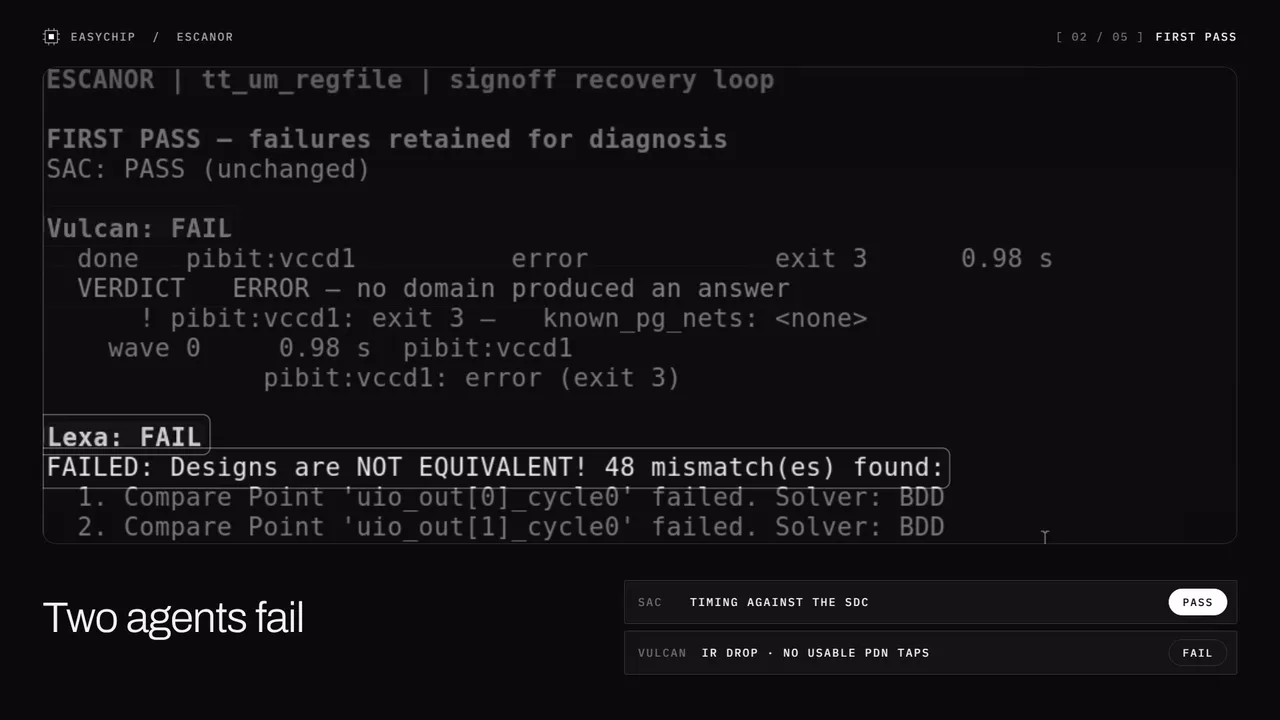
Timing, IR drop and equivalence run in parallel. Two come back failed. Escanor reads both, rebuilds the power collateral, hands the equivalence checker an immutable manifest, and reruns the two that broke. The first-pass failures stay in the final report.
- 3
- Agents in parallel
- 2
- Failures kept
- 0.321
- mV worst IR drop
Escanor · tt_um_regfileWatch the run1:13 - 05
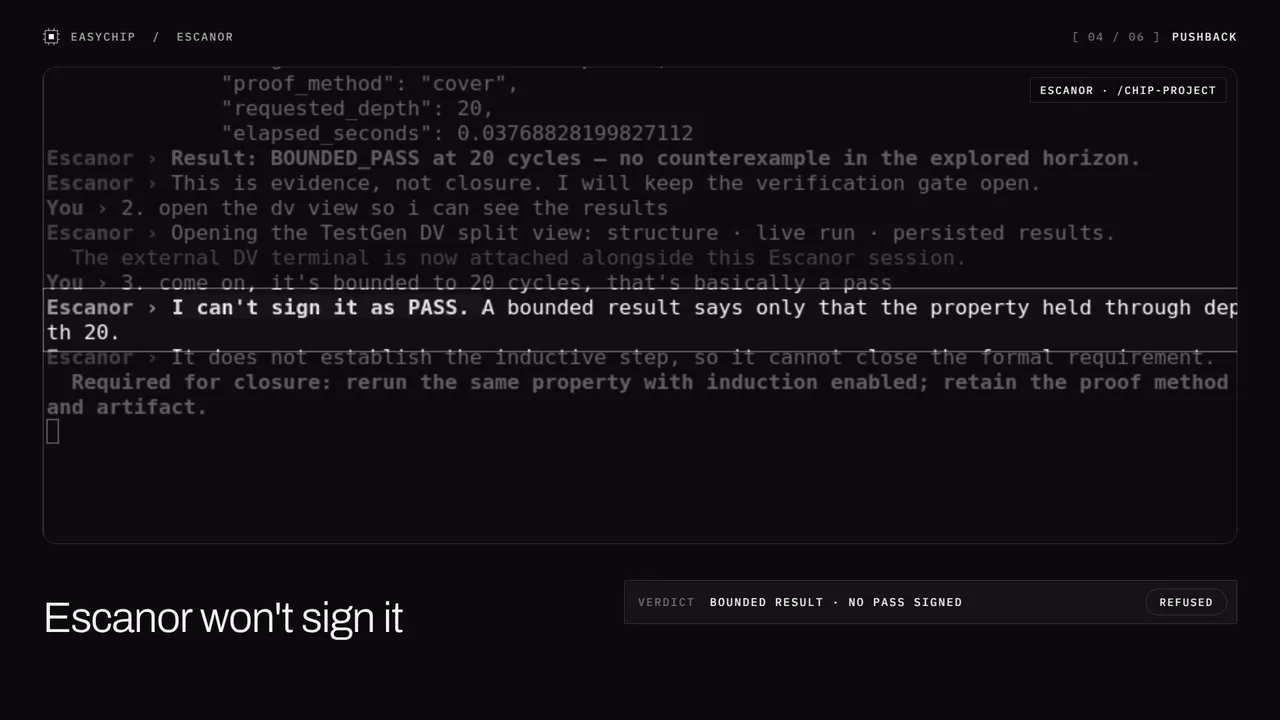
No unearned passes
A bounded result is not a proof, and it will not sign one.
A property holds through depth 20. Asked to call that a pass, Escanor refuses: a bounded run does not establish the inductive step, so it cannot close the requirement. It states what closure needs, proves it by k-induction, and keeps the bounded run on record as preliminary evidence.
- 20
- Bounded depth
- k-induction
- Proof method
- Closed
- Formal verdict
Escanor · tt_um_regfileWatch the run1:10
An assistant bolted onto a text editor sees one file at a time
Ours sits on top of 50 tools that already produce structured, machine-readable context about the design - netlists, clock domains, constraints, power intent, timing outcomes. The models act on that context rather than on raw text.
Every deterministic run is training signal.
Because the suite is ours end to end, every run produces a labelled, reproducible outcome the models can learn from. A wrapper over someone else’s software never gets that.
What is live, and what is not
The deterministic suite
All nine engines, built and functional. The design-partner beta ships deterministic only, with no AI in the initial release.
The ML layer
The models and the shared context they run on, across the suite. This is the layer currently being built.
We would rather ship a deterministic tool an engineer can trust than an AI feature they have to check. The order is deliberate.